
Key Takeaways
- RIA valuation is not a single formula; it's an assessment of risk, durability, and growth potential, with EBITDA multiples being a common anchor for established firms.
- Key operational drivers that move multiples include client retention and concentration risk, the rate of organic growth from net new assets, and the firm's adjusted EBITDA margin and advisor capacity.
- Headline multiples reported in industry deals often include contingent earnouts, meaning the effective multiple a seller receives may be materially lower than the announced figure.
- Revenue quality can matter as much as quantity. Acquirers evaluate the composition of revenue, favoring predictable, recurring AUM-based fees over less stable project-based or transactional income.
- Operational maturity, demonstrated through documented and repeatable workflows for analysis and reporting, can signal lower integration risk and cost to a potential buyer.
Most advisory firm owners first encounter their firm's value as a single number, a multiple of revenue or, more commonly, adjusted EBITDA. It's natural to anchor to that figure as the definitive answer to the question, "What is my business worth?" Yet the reality of RIA transactions is far more nuanced. Two firms with comparable AUM and similar trailing twelve months revenue can receive materially different offers, and the headline multiple alone may not explain the difference.
The factors that widen or narrow that gap play a significant role in how a firm's value is assessed. Revenue composition, client demographics, organic growth rate, and operational maturity are not just talking points; they are important considerations that inform a buyer's pricing model. An acquirer is buying a stream of future cash flows rather than a static book of assets, and key aspects of a firm's operations are scrutinized to assess the predictability and durability of that stream.
This article is not intended to prescribe a valuation methodology or recommend a deal structure. Its purpose is to help firm owners and leadership teams understand the key drivers acquirers evaluate and which characteristics are within a firm's influence long before a transaction is contemplated.
This content is for informational purposes only and does not constitute investment, legal, tax, or compliance advice. Consult with qualified professionals before making any financial decisions.
RIA Valuation Methods and When Each One Applies
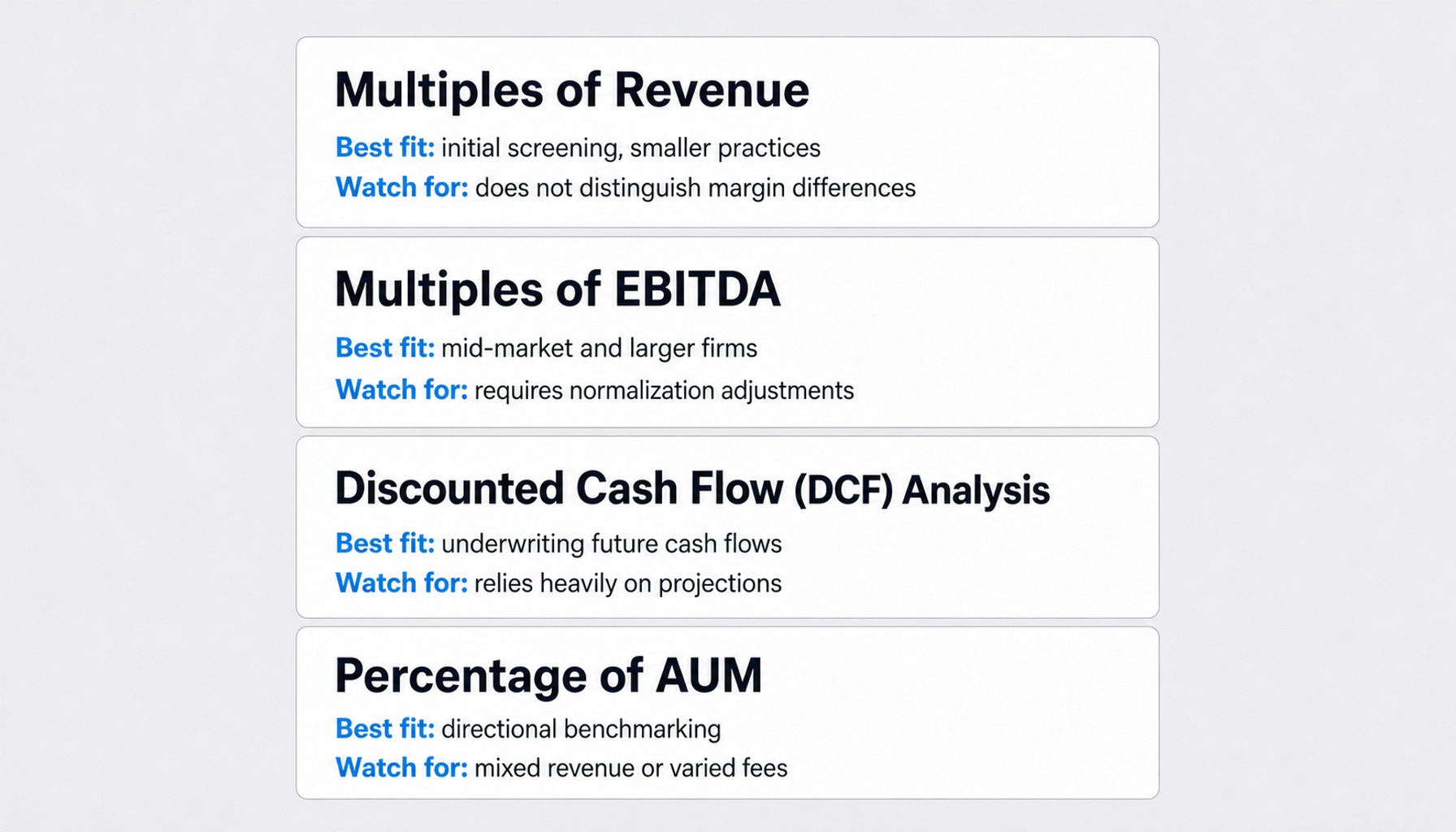
There is no single correct method for valuing an RIA. The most appropriate approach depends on the firm's size, margin profile, growth outlook, and the buyer's specific investment thesis. In practice, revenue and EBITDA multiples are often used as headline reference points, while a discounted cash flow analysis can provide a more direct view of how a buyer is underwriting future cash flows.
-
Multiples of Revenue: This method applies a multiple to a firm's trailing twelve months (TTM) revenue. It is often used for initial screening or for smaller practices where reliable profitability data may be limited. While simple to calculate, its primary limitation is that it does not distinguish between high-margin and low-margin firms. For example, consider two hypothetical RIAs, each with $5 million in TTM revenue. If one had a 40% EBITDA margin and the other a 20% margin, a revenue multiple would treat them identically, even though their actual earnings would differ substantially.
-
Multiples of EBITDA: For many mid-market and larger RIA transactions, a multiple of adjusted Earnings Before Interest, Taxes, Depreciation, and Amortization (EBITDA) is a common valuation anchor. This approach focuses on operating profitability, which gives buyers a clearer picture of a firm's financial health. The key is "adjusted" EBITDA, which involves normalizing for items like above-market owner compensation, one-time legal fees, or other non-recurring expenses to reflect the firm's true ongoing earning power.
-
Discounted Cash Flow (DCF) Analysis: A DCF model estimates value by projecting future cash flows and discounting them back to present value based on perceived risk. This method gives more weight to assumptions about organic growth, client retention, margin sustainability, and capital needs, which makes it especially useful when a buyer is focused less on market shorthand and more on the firm's future economics. In many transactions, even when multiples are used for headline framing, DCF logic still sits underneath the buyer's internal underwriting.
-
Percentage of AUM: Sometimes expressed in basis points (bps), this model is often used as a rough benchmarking reference for fee-based firms with relatively consistent billing structures. It can be directionally useful, but it is generally less comprehensive than revenue, EBITDA, or cash flow based approaches because it does not fully capture fee schedule variation, margin differences, client concentration, or the mix of AUM-based and non-AUM revenue. Its utility also diminishes when a firm has significant held-away assets .
The Operational Drivers That Move Multiples Up or Down
The valuation method establishes a framework, but the operational characteristics of the firm significantly influence where within a wide valuation range the actual price falls. Acquirers are assessing risk, revenue durability, and growth potential. The following drivers are not a simple checklist but represent the core categories buyers use to quantify that assessment.
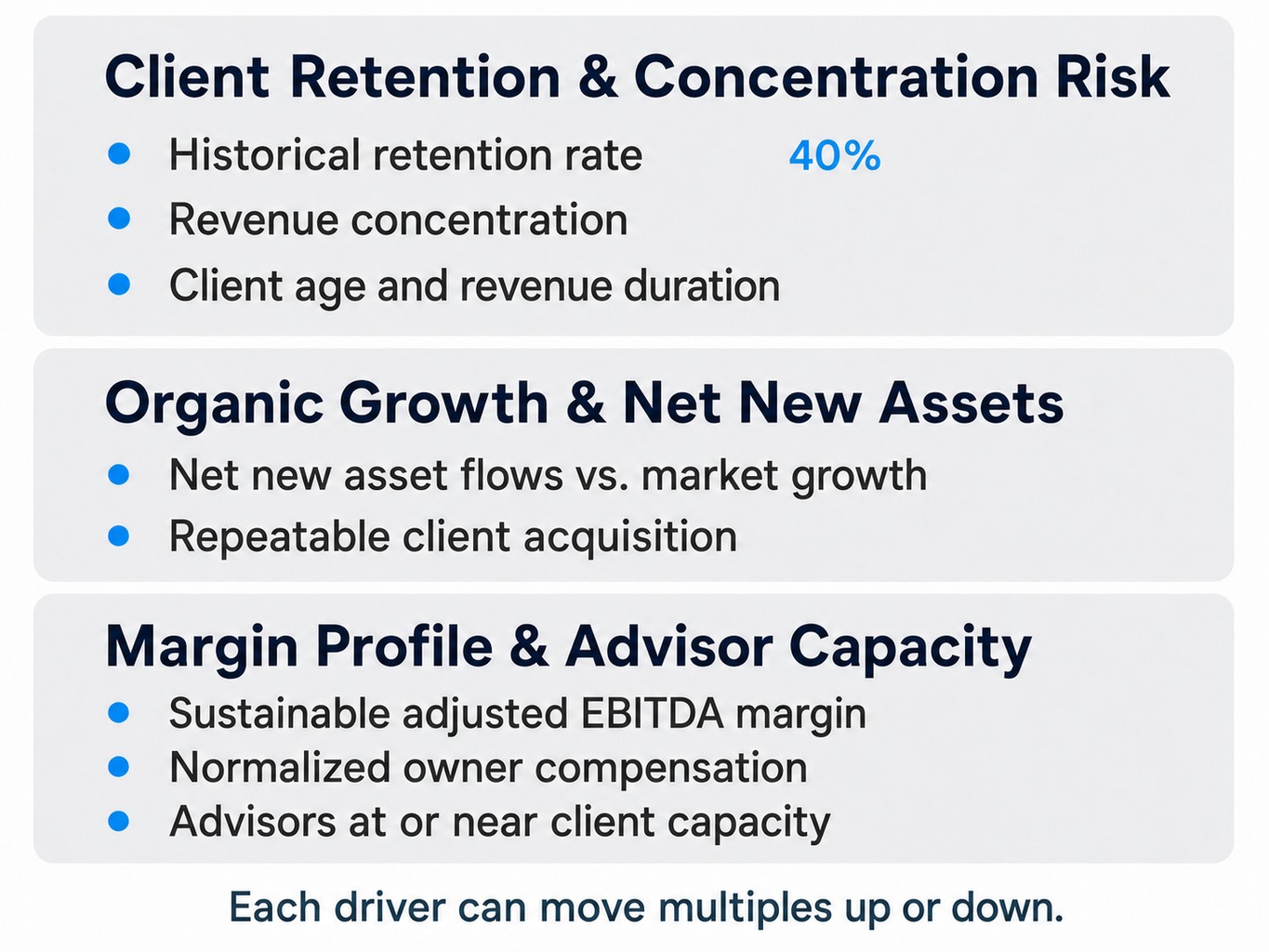
Client Retention and Concentration Risk
Client retention rate is a closely scrutinized metric in RIA due diligence because it informs a buyer's confidence in post-close revenue durability. A history of high, stable retention suggests strong client relationships that are likely to transfer to the new owner.
Conversely, high client concentration presents a significant risk. If a large percentage of a firm's revenue is tied to a small number of relationships, the buyer faces heightened key-person and relationship-transfer risk compared with a more broadly distributed client base. This concentration risk often compresses the offered multiple or shifts a larger portion of the purchase price into contingent components like earnouts. Furthermore, the demographic profile of the client base, specifically the asset-weighted client age, can also influence long-term revenue assumptions, as an older base may imply a shorter revenue duration.
Organic Growth Rate and Net New Asset Flows
Acquirers draw an important distinction between AUM growth driven by market appreciation and growth driven by net new asset flows. Net new asset flows are a key measure of organic growth, but definitions can vary across firms and reporting methodologies. In many valuation discussions, net new flows carry more weight than market-driven AUM increases because they can indicate whether the firm is attracting and retaining client assets through its own efforts rather than benefiting mainly from market appreciation.
Sustainable organic growth can be a stronger indicator of long-term business value than AUM increases driven primarily by market appreciation. Repeatable prospect acquisition, advisor capacity to absorb new relationships, and consistent workflows for analysis, proposal generation, and follow-through can all help demonstrate that growth is not purely episodic. A related indicator is the referral conversion rate, the percentage of referred prospects who ultimately become clients, which can reflect the consistency of that acquisition process.
Margin Profile and Advisor Capacity
A firm's adjusted EBITDA margin signals how efficiently it converts revenue into profit. Buyers evaluate not only the current margin but also its sustainability. A high margin might look attractive, but if it is the result of under-investment in technology, deferred hiring, or below-market staff compensation, an acquirer will model the future costs required to normalize operations, effectively reducing the pro forma EBITDA.
This ties directly to advisor capacity. A firm where advisors are at or near their client capacity has limited ability to drive future organic growth without adding headcount and infrastructure. This affects a buyer's growth model and the price they are willing to pay for that growth. Normalized owner compensation is another relevant adjustment here; the difference between what a founder pays themselves and the market rate for a replacement CEO or lead advisor can materially change the adjusted EBITDA figure used for valuation.
Why Headline Multiples and Effective Multiples Often Diverge
Industry reports and deal announcements cite headline multiples that can differ from what firm owners ultimately realize. These figures can reflect the maximum potential purchase price if all contingent terms are met, rather than the amount a seller receives at closing or over the life of the deal. Deal structure is a common source of the gap between the headline multiple and the effective multiple.
Three common mechanisms cause this divergence:
-
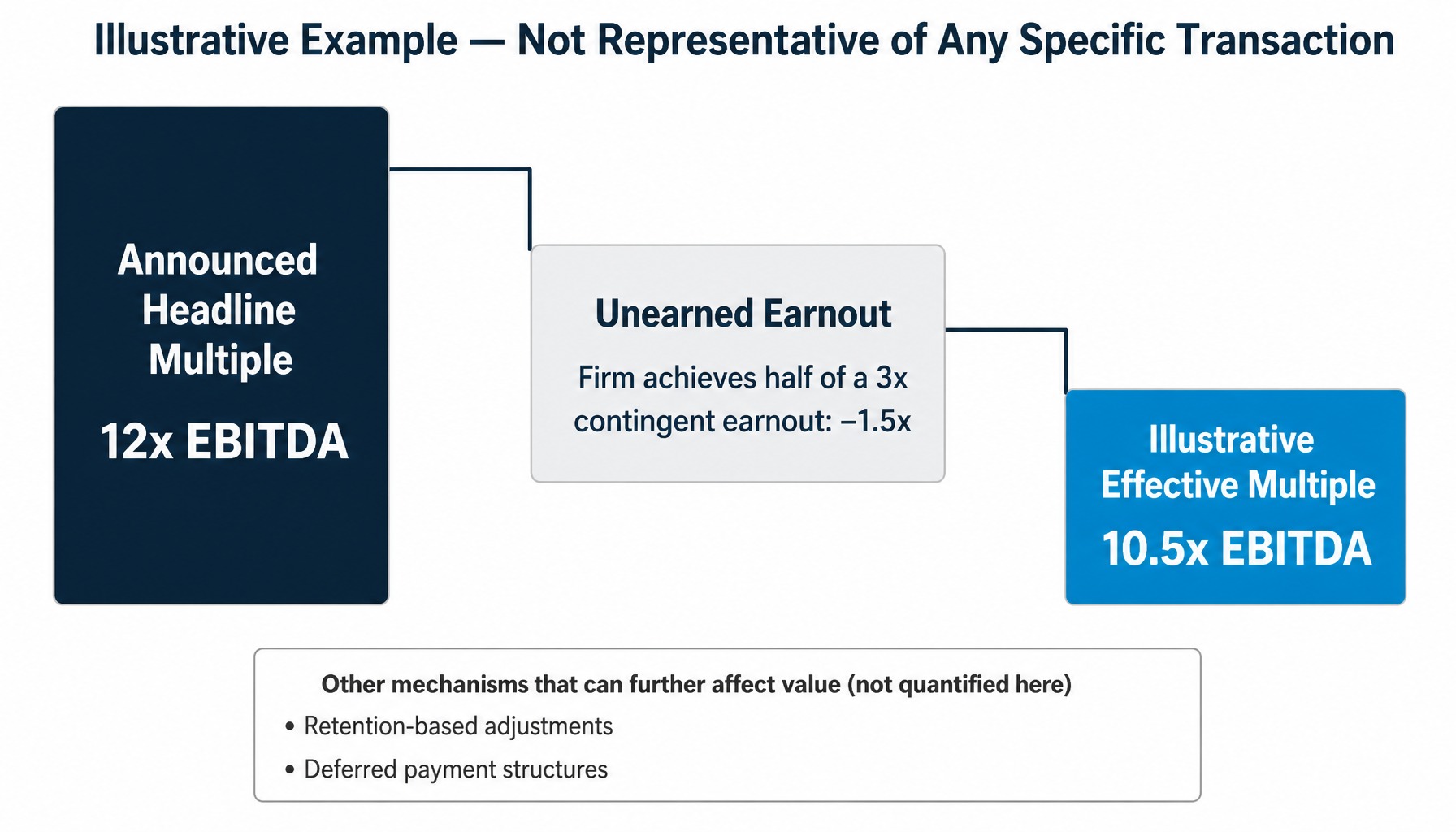
Earnout Provisions: A significant portion of the purchase price may be contingent on the firm achieving specific post-close performance metrics, such as client retention or revenue growth targets. Depending on the terms of the agreement, that portion of the payment may be reduced or forfeited if these targets are not met, so the specific provisions are worth reviewing with qualified legal counsel. The earnout structure effectively requires the seller to share in the post-close execution risk.
-
Retention-Based Adjustments: Many agreements include clauses that reduce the purchase price if client attrition exceeds a negotiated threshold during a specified transition period. This directly protects the buyer from paying for revenue that does not successfully transfer.
-
Deferred Payment Structures: It is common for a portion of the purchase price to be paid out over several years. These deferred payments carry an implicit time-value-of-money discount and may also be tied to the seller's continued employment, further separating the headline number from the present-day cash value.
For a simplified hypothetical example, a deal announced with a 12x EBITDA multiple might include 3x in contingent earnout payments. If the firm achieved only half of its earnout targets, the seller would realize an effective multiple of 10.5x. This example is intended only to illustrate the mechanics of earnouts and does not account for other deal considerations, such as payment timing, financing terms, working capital adjustments, or other negotiated purchase price changes.
Revenue Composition May Matter More Than Total AUM
Two firms with identical AUM can have different revenue profiles, and acquirers often factor this distinction into their valuations. The quality and predictability of revenue are scrutinized alongside the total AUM figure.
Recurring, AUM-based advisory fees are often valued favorably because they can provide recurring revenue visibility and are relatively straightforward to model. That said, they are not insulated from risk. AUM-based revenue remains sensitive to market performance, client withdrawals, household attrition, and fee compression over time. In contrast, revenue from project-based financial planning, hourly fees, or commissions is often viewed as less stable and may not transfer as cleanly to a new owner, as there is no guarantee of recurrence. A firm with substantial AUM may look strong on the surface, but if a material portion of its revenue comes from non-recurring planning projects, a buyer is likely to model that revenue stream with a higher degree of risk.
The weighted average fee rate, or basis point yield on AUM, also matters. It signals a firm's pricing power and client segment focus. A firm with a higher fee schedule may face greater risk from fee compression, and a buyer may model future revenue attrition if they believe current fees are above sustainable market rates.
How Technology and Workflow Maturity Factor into Acquirer Assessments
When a potential buyer evaluates a firm's technology stack, the focus is typically less on a list of software features and more on estimating an integration cost. The more fragmented, manual, or advisor-dependent a firm's core workflows are, the more they can influence how buyers assess integration costs, scalability, and operational risk.
Documented, repeatable processes for client data intake, portfolio analysis, proposal generation, and client reporting signal operational maturity. Acquirers often look at whether these workflows are systematized and portable or depend on each advisor's own combination of spreadsheets and manual data exports, as this informs their view of integration risk. Undocumented, advisor-specific workflows may be viewed as a source of key-person risk.
Data portability is a central concern. If client portfolio data, historical analytics, and presentation materials are locked in disconnected, proprietary systems, the buyer would likely factor in the cost and complexity of migrating that information. For that reason, a firm's investment in a consistent operational infrastructure is not just about internal efficiency; it can give a buyer clearer operational visibility into how the firm runs, contributing to the perception of a well-run, scalable organization.
Read more: Automation in Wealth Management: Why Half-Automated Workflows Can Create More Risk Than Manual Ones
Building the Operational Foundation That Supports Valuation Readiness
A common challenge for many firms is that while they recognize the importance of operational consistency, their day-to-day reality involves fragmented tools and advisor-dependent processes that are difficult to systematize. This creates a gap between knowing what acquirers value and being able to demonstrate it.
One place this gap often appears is the prospect-to-proposal workflow, the steps that take a prospective client from initial statements, through an objective evaluation of the existing portfolio's characteristics, to a final proposal. When that work is repeatable, it is easier to document and to transfer. The VRGL Growth Platform is designed to help firms bring this client workflow into a more consistent process, supporting the kind of operational maturity that can increase efficiency and reduce manual friction. Its core capabilities include extracting data from prospect statements and applying portfolio analytics to that data, helping firms standardize important parts of the work behind advice.
This focus on workflow consistency can help firms establish well-documented processes long before a transaction is on the horizon.
See how VRGL supports a more consistent prospect-to-proposal process.
Conclusion
An RIA valuation is less a formula applied to a firm than a reflection of how an acquirer assesses the durability, transferability, and scalability of its revenue, client relationships, and operations.
Understanding which valuation method applies is the starting point. However, the operational drivers, revenue composition, and workflow maturity are areas where firms have meaningful influence over how their value is perceived. Treating valuation readiness as an ongoing operational discipline, rather than a last-minute exercise before a sale, can help firms understand and communicate the value they have built.
Frequently Asked Questions
1. What is a quality of earnings report and when is it typically used in RIA transactions?
A quality of earnings (QoE) report is a third-party financial analysis, typically commissioned by a buyer during due diligence, that validates the sustainability of a firm's reported earnings. It examines normalized EBITDA and assesses whether revenue and margins are likely to persist post-transaction. Understanding what a QoE evaluates can help firms address potential concerns proactively.
2. How does the asset-weighted age of a client base influence valuation assumptions?
Acquirers often model the expected duration of revenue based on a firm's client demographics. A client base with a higher asset-weighted average age may imply a shorter revenue duration as clients enter distribution phases or transfer wealth. This doesn't automatically reduce valuation but can affect a buyer's long-term projections and the structure of contingent payments.
3. What is the typical timeline from initial valuation to closing an RIA transaction?
Timelines vary based on deal complexity, but many transactions take several months from initial engagement to closing. This period includes time for due diligence, negotiation of definitive agreements, regulatory filings, and client notification processes. Qualified legal and M &A professionals can help firms understand the specific steps and timing involved.
4. How do internal ownership transitions differ from external sales in terms of valuation?
Internal transitions, where a founder sells to partners or employees, often involve different pricing dynamics. Internal buyers may have less access to capital, leading to structures with longer payment terms or seller financing. While the valuation methodology may be similar, the deal structure and the weight placed on relationship continuity often differ from an external sale.
5. Can a solo advisor estimate their practice value before engaging a formal valuation firm?
A solo advisor can develop a preliminary estimate by analyzing trailing twelve months revenue, approximate profit margins after normalizing their own compensation, and key metrics like client retention and concentration. General benchmarks can provide directional context, but a formal valuation is typically needed for transaction-level accuracy.